
Gerrymandering in Utah
The status of Utah's fight for fair representation—and on gerrymandering nationwide
“We affirm that gerrymandering, both racial and political, disenfranchises voters.”
—Virginia Kase Solomón, president and CEO of Common Cause
Partisan gerrymandering has dominated the news lately, but it’s nothing new—although gerrymandering is interestingly, primarily a US-specific problem. The term originated all the way back in 1812 after Massachusetts Governor Elbridge Gerry drew a map to help his party win the next election.
So begins our inglorious tradition.
In places like Oregon, where I grew up, Democrats have often gerrymandered to favor their party. I’ve never liked this.
In Utah, where I now live, our Republican state legislature gerrymanders to create safe districts for themselves and their party members. To illustrate, one of my real-life friend's ward boundaries—a small geographically-based church congregation of roughly ~500 people in a devout area south of Salt Lake City—includes all four of Utah’s congressional districts. Neighbors represented by different officials in Washington.
Frankly, I find gerrymandering antithetical to ethical government. If you can’t win fairly… cheat? Not what I want to teach my kids.
Moreover, gerrymandering makes elections less competitive, meaning elected officials tend to be less responsive to their people. No matter the party you're from, this is bad for any type of representative government.
Anti-gerrymandering efforts in Utah
In 2018, a Utah group called Better Boundaries ran a ballot initiative against gerrymandering. Their initiative was aimed at forming an independent redistricting committee to reduce partisan bias in state and federal maps. SSpoiler: the initiative not only qualified for the ballot, it passed! (Hooray for good government, right?)
The Better Boundaries initiative was actually a major feat.
As background, Utah has one of the most onerous ballot initiatives in the nation. Any such initiative must collect verified signatures from 8% of active registered voters statewide in Utah in at least 26 of the 29 state senate districts to even qualify to be on the ballot. That means gathering hundreds of thousands of signatures within a short timeframe—and many are thrown out. Initiatives in Utah take millions of dollars and a horde of committed signature-gatherers to accomplish.
Suffice it to say that getting a ballot initiative on the ballot—then passed at the ballot box—is not easy. Yet pass it did, because it turns out that most Utah voters do prefer better representation to hyper-partisan politics.
The Better Boundaries initiative "aimed at creating an independent redistricting commission that would redraw political boundaries after the 2020 Census, the intent being to eliminate gerrymandering — or drawing political boundaries benefiting one party to the detriment of another." (Salt Lake Tribune)
After the rubber met the road, the next time districts were being drawn up, Utah’s state legislature changed the initiative ex post facto… to make the commission just “advisory.”
New Maps
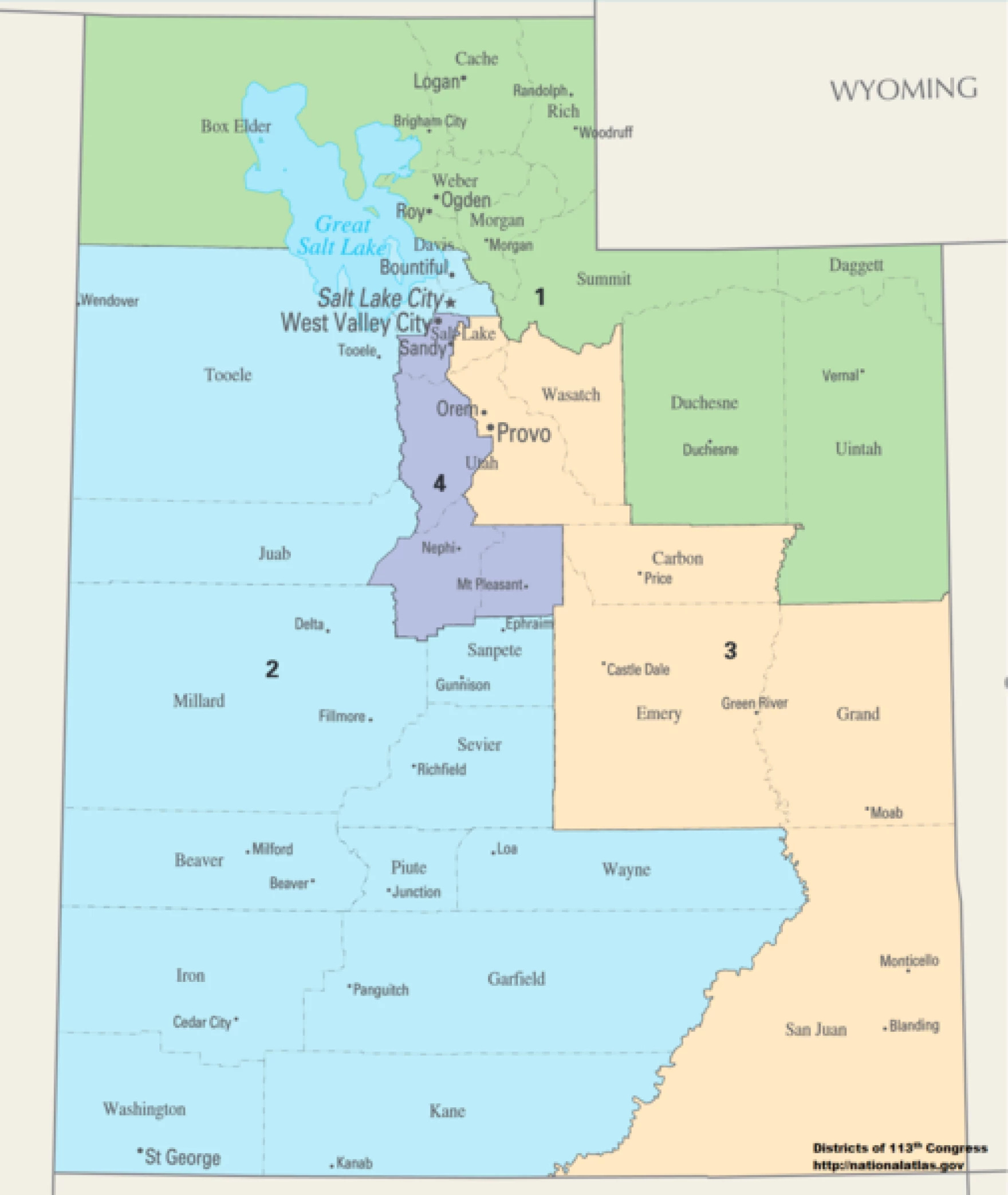
Then in 2021, during its new redistricting process, Utah’s Republican supermajority legislature threw out all twelve of the independent commission’s proposed maps and quickly made its own map. So quick it allowed for very little public input. I remember it well, feeling aghast as my husband and I frantically tried to give feedback and speak for impartial maps in the hours before the map passed. It may have been the first time I reached out specifically to my state legislator.
The new map sliced up neighborhoods and put widely disparate areas together—if you know Utah, one district spans from north of Bountiful (north of Salt Lake City) to southern St. George (bodering Arizona). All within one district.
Seeking to concentrate party power under the guise of unity.
At the time, Utah was represented in the US House by 3 Republicans and 1 Democrat: fairly representative of Utah voters. However, since the 2021 legislative-drawn maps made these congressional seats uncompetitive, and all seats have been won and held by Republicans. Utah’s gerrymandered maps also affect the composition and competitiveness of Utah’s own house and senate. For instance, my own neighborhood’s precincts were drawn bizarrely to help ensure victory for one local legislator. So fun for democracy.
A Win for the People
In early 2022, a lawsuit was filed against these gerrymandered maps. This process hasn’t been quick. Last summer, in mid-2024, the Utah Supreme Court unanimously ruled for the plaintiffs—i.e., against gerrymandered maps. All five Republican-appointed judges found the legislature’s actions egregious and unconstitutional.
Tonight, yet another judge ruled that the 2021 legislative maps did not comply with Utah’s constitution or the 2018 Better Boundaries initiative. The judge’s ruling went further—throwing out existing maps and prohibiting them from being used in any future election. Utah’s legislators now have 30 days to draw new maps (and if you’re a Utah resident, they need to hear from YOU!)
Judge Dianna Gibson’s ruling Monday evening prohibits the current congressional maps from being used in any future election and gave the state lawmakers until Sept. 24 to adopt new boundaries that comply with Proposition 4, the citizen-passed initiative.
In her 79-page ruling, Gibson wrote that the Legislature “intentionally stripped away all of [the initiative’s] core redistricting standards and procedures that were binding on it.”
“To permit the 2021 Congressional Plan to remain in place would reward the very constitutional violation this Court has already identified and would nullify the people’s 2018 redistricting reform that they passed through Proposition 4.”
Essentially, the judge said that the people of Utah voted against gerrymandering. That maps should be drawn fairly.
Why is this controversial?
I can hardly believe this ruling is controversial. Ethics demands that we put aside our personal preferences to support what is right… right? But being upset about anything that doesn’t favor “our” side is the politics of today, apparently.
After the more-than-seven-year process to gain better, less partisan boundaries in Utah, today’s ruling comes at the peak of attention on gerrymandering. Turning attention back to the Beehive State.
Gerrymandering recently recaptured national attention after President Trump, unusually, requested Texas redistrict mid-decade to favor Republicans in the upcoming election. (Apparently he doesn’t think his party can win on merit alone; they must weight the dice).
California is now threatening to do the opposite—to redistrict in order to give more seats to Democrats. Although California has now (actually) used an independent redistricting commission for many years, this push may succeed. More states may potentially follow suit.
Fair maps
More gerrymandering is precisely the opposite of what I want to happen.
I want fair districts overall. Less gerrymandering, or as little as possible. Call me naive, but still I’m holding onto some hope for less partial, better maps nationwide—and I’m not the only one:
“Gerrymandering opponents say the current moment has the potential to produce new energy for their movement. More people are paying attention to gerrymandering, they say, and new polls show the public opposes the practice. The rush to redraw maps demonstrates the need for Congress to set national limits, they say. (Stateline)
I hope more Americans can see this partisan rancor for what it is and support fair maps nationwide. To his credit, a House California Republican proposed a national anti-gerrymandering bill.
Back to Utah. Today is a win for those who want to be fairly represented, regardless of party affiliation. Unfortunately, this particular fight is not over. Realistically, today’s judicial decision against gerrymandering in Utah will be appealed, perhaps once again to Utah’s Supreme Court, perhaps to the United States Supreme Court. Whether the legislature, which has so far dragged this court case out for over three years, will succeed in keeping their maps through 2026… it’s possible.
But today’s ruling reminds us that, sometimes, the people’s voices are actually too strong to be ignored. As the Utah judge noted,
“The nature of the violation lies in the Legislature’s refusal to respect the people’s exercise of their constitutional lawmaking power and to honor the people’s right to reform their government” (AP).
I believe the people deserve a say in their government. And if we want fair representation, reform we must.
May we all come together, regardless of our party and political preferences, to say “no more” to gerrymandering. To stand up for principles of fairness and representation.
Our nation so desperately needs it.
Nice post, glad to hear the good news.
Seems plausible to me that the decline of competitive districts drives (at least in part) our bonkers political reality.